
.
Image: Mario Tama/Getty Images
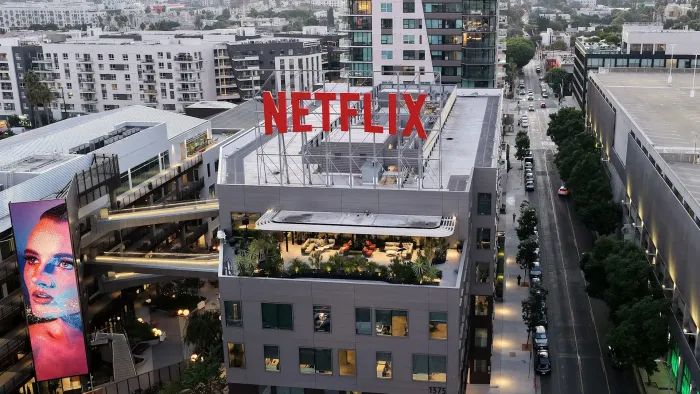
The battle for Warner Brothers Discovery got hotter this week as Paramount launched a hostile bid of $108.4 billion for the company, topping Netflix’s agreement last week to pay nearly $83 billion for the company’s streaming and studio assets.
It’s the largest M&A deal of 2025 and rightfully will receive tough scrutiny in the U.S. and Europe. The ultimate price for Warner Brothers Discovery will certainly factor heavily into who wins the fight, especially with investors, and there could be additional bidders and proposals.
For sure, an acquisition by Netflix of one of the oldest Hollywood studios, Warner Brothers, and its HBO Max streaming service would have ripple effects across the industry, though not in the way critics contend.
Sen. Elizabeth Warren called it an “anti-monopoly nightmare” that would harm consumers and American workers. Actress Jane Fonda, who’s appeared in successful Netflix shows and movies, called it “catastrophic.” Titanic director James Cameron declared it a “disaster.” Roy Price, the former head of rival Amazon Studios, penned a New York Times editorial proclaiming “the end of Hollywood.”
Such histrionics forget how Netflix already slowly yet systematically reordered the global entertainment industry over the last 25 years through a strategy of addition, not subtraction. By innovating from the margins, Netflix challenged outdated models, rewarded risk-takers, and gave consumers more control for better value. In doing so, it created countless opportunities for all stakeholders.
Traditional antitrust reviews focus on market share and whether the resulting combination has the power to harm consumers and competitors alike. Key will be how narrowly or broadly antitrust authorities define the market. For example, will they evaluate the deal solely on streaming TV services, all TV including broadcast and cable, or all entertainment options including games, music, etc. But even in the narrowest of interpretations, a Netflix-HBO combination would still face steep competition from well-funded rivals such as Disney, Amazon, Comcast, Apple, and Paramount.
And this merger review will have the added intrigue of President Trump already making clear he’ll be directly involved in deciding which offer gets approved despite his son-in-law Jared Kushner partially funding Paramount’s bid.
With all that said, Paramount has already mounted an aggressive roadshow for Warner Brothers Discovery investors to convince them to pledge their shares. That means Netflix too will need to woo investors, regulators, and politicians in what will undoubtedly be its biggest publicity tour ever. And the strongest argument it can make lies in its very own story.
Full disclosure: I led Netflix corporate communications team from 2014 to 2017, know the company deeply, and remain a shareholder. I also led PR for other corporate mergers including Xerox’s hostile bid for HP until the effort was scrapped due to the pandemic. I served as lead antitrust reporter at Bloomberg News during the late 1990s.
Today many people look at Netflix and see an entertainment behemoth valued at more than $400 billion with a lot of market power. But it didn’t start out that way and its success certainly wasn’t assured.
In its most fundamental sense, Netflix epitomizes the American Dream. Not because it became big, but because it began small and showed how ordinary people with a better idea and a lot of grit could upend well-entrenched industries. Netflix demonstrated when you level the playing field and bet on people instead of institutions, you unleash possibility that couldn’t previously be imagined.
Netflix has been underestimated at every turn, perhaps even this latest one. In the early days, banks turned it down for financing, Blockbuster Video executives laughed them out of the room and former Time Warner CEO Jeff Bewkes famously dismissed the company as the equivalent of “the Albanian army,” suggesting it was no threat at all.
Netflix didn’t succeed by manipulating government loopholes or seeking regulatory protections to fend off competition. It identified a compelling need in the marketplace, analyzed how new technologies could solve it, and got to work building an alternative. It took risks, learned, pivoted, and kept moving, leaving no aspect of the entertainment experience untouched.
Candidly, it would be hard to overstate the many ways Netflix’s very existence benefited consumers, the entire entertainment ecosystem as well as adjacent markets such as consumer electronics, telecom, tech, marketing, language translation, and more.
From the start with mail-order DVDs and then as a streaming platform, Netflix put consumers and their pain points at the heart of its decision-making. For example, I recall numerous meetings where we discussed whether price increases should go into effect for inactive accounts. (Short answer: No. In fact, I believe Netflix is now cancelling inactive accounts rather than continuing to charge people.) It partnered wherever possible even with would-be competitors to simplify, expand, and enhance the entertainment experience.
When Netflix launched original streaming content in 2012-2013, the company didn’t just usher in a new Golden Age of TV. They changed everything from how content was made, released and experienced within the broader ecosystem. How?
Here are just a few ways:
Netflix attracted more than 300 million subscribers by building the world’s most powerful global distribution platform and ensuring its content is easy to access and enjoyable to watch. It’s not in the company’s business interests to horde content made by Warner Brothers and nothing in its history would suggest such an approach.
As for the theater owners expressing concern, their stiff-arming of Netflix led the company to buy its own theaters in L.A. and NYC to premiere movies so they could be awards eligible. This combination may finally force them to face society’s viewing evolution and up their game to attract more theatergoers.
Both co-CEOs at Netflix—Ted Sarandos and Greg Peters—are impressive. But if Netflix’s corporate story is one of the American Dream, it’s the same for Ted’s personal one.
I often thought Ted must wake up every day and say “pinch me.” Because nothing about his childhood would make anyone think he’d be in the lofty position he is today at the top of an industry he deeply and thoroughly loves.
One of five children, he grew up in a working class, Greek-American family in Phoenix, where he often recalled watching videotaped soap operas and other shows with the whole family gathered round. He dropped out of college after two years and worked at the local video store near his home. It was after he began climbing the ranks at video rental companies that Netflix cofounder Reed Hastings reached out and sold him on the idea of joining Netflix.
The rest, as they say, is history. As the chief content officer prior to co-CEO, Ted was the main driver behind the company’s move into original programming. Through a combination of passion, charm, and high intuition, he built the company’s credibility in a clubby industry that long looked askance at outsiders.
Not only did his American Dream unfold alongside Netflix’s, he’s a highly skilled communicator, who connects with people in a very human way through personal storytelling and warmth. And with critics concerned about how Netflix’s tech pedigree might change old Hollywood, Ted’s love for all things and people Tinsel Town oozes from every pore.
When we launched Netflix globally in early 2016, we used #NetflixEverywhere to mark the moment. That edict has never been more appropriate and necessary in the battle for Warner Brothers Discovery.
Netflix will need to actively tell its story to every audience on repeat for the next 12–18 months or, as we’ve already seen, risk having its many detractors push unflattering and perhaps even untrue counternarratives.
Media interviews, major business and investor conferences, and congressional meetings all provide the opportunity to remind decision-makers and would-be critics that success itself isn’t a problem if it was obtained fairly and by serving customers better than others. It’s not like other companies didn’t have ample time to beat Netflix at their own game over the last 10–15 years.
And no one loves a come-from-behind story better than the guy in the Oval Office.
ABOUT THE AUTHOR
Anne Marie Squeo is the founder and CEO of Proof Point Communications, a boutique marketing and communications firm, and a Pulitzer Prize-winning business journalist.
