
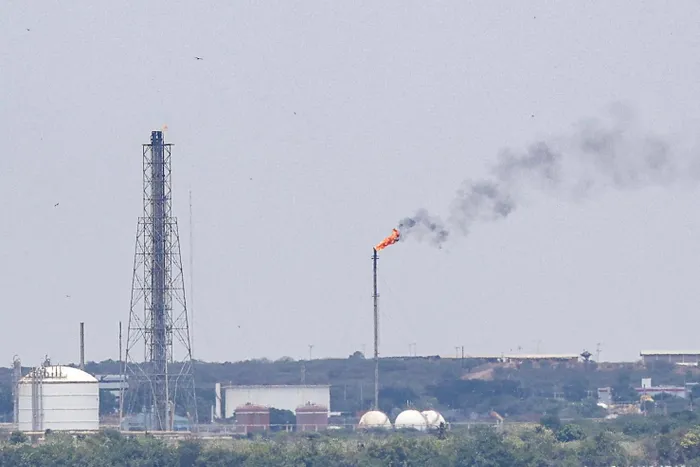
An Oil refinery is seen from Maracaibo, Zulia State, Venezuela on March 19, 2025.
Image: AFP
Venezuela’s oil sector, long a linchpin of global crude markets yet deeply damaged by years of mismanagement and sanctions, is now at the centre of dramatic geopolitical transformation.
Recent events, especially the removal and capture of President Nicolás Maduro by U.S. forces and the subsequent U.S. policy shift, have triggered global market reactions, renewed corporate interest, and calls for massive capital investment.
Venezuela holds the world’s largest proven oil reserves, roughly 303 billion barrels, about 17 % of the global total. Despite this massive endowment, output has collapsed from over 3.5 million bpd in the late 1990s to around 800,000–900,000 barrels per day today due to chronic underinvestment, political instability, and ageing infrastructure, according to Axios.
Venezuela’s state oil company, Petróleos de Venezuela, S.A. (PDVSA) was created in 1976 when the government nationalised foreign oil assets and became one of Latin America’s largest companies.
Over decades, however, PDVSA has struggled with inefficiency, debt defaults, and productivity loss.
In late 2025, the U.S. significantly escalated pressure on the Maduro government through sanctions and a naval blockade/quarantine against sanctioned Venezuelan oil tankers, part of a broader campaign linking energy policy to anti-narcotics objectives.
In early January 2026, US forces captured Maduro, raising global attention on Venezuela’s oil as a strategic asset.
The Trump administration has since taken steps to control Venezuelan oil sales and revenues indefinitely, funnelling proceeds through U.S. accounts and stabilising exports to American and other markets.
What does this mean:
The US is directly managing Venezuelan crude sales and considering mechanisms to compensate foreign oil investors willing to rebuild the industry.
The Guardian noted that the US may plan to sell up to 50 million barrels of Venezuelan oil into global markets, with proceeds earmarked for the Venezuelan people.
State Actor
PDVSA remains the dominant state oil firm holding controlling stakes in national production and export infrastructure, though its operational capacity is severely diminished.
International Oil Majors
Chevron: The only US major still active in Venezuela under special licenses and potentially first to expand operations under US oversight. It should be noted that discussions are underway to expand Chevron’s license, allowing a return to previous export volumes and broader sales.
ExxonMobil & ConocoPhillips: These long-standing former operators exited following early 2000s nationalisations but may return as legal and political barriers ease. Their expropriation claims could be settled via drilling rights or compensation tied to future production.
Foreign Partners (Past and Present)
China’s CNPC and joint ventures like Sinovensa have historically participated in heavy crude extraction, though under sanctions, the scale of operations diminished.
European firms such as Repsol have expressed interest in re-entering if licenses and legal stability are guaranteed.
Rebuilding Venezuela’s oil sector is not a short-term project; analysts estimate tens to hundreds of billions of dollars in upstream investment are needed over decades to restore infrastructure, drilling capacity, and export logistics.
With sanctions fully lifted and capital inflows, output could rise toward 1.1–1.2 million bpd by year-end 2026, with potential to exceed 1.7–1.8 million bpd by 2028 if sustained investment continues.
Venezuela’s heavy crude historically commanded price advantages in Gulf Coast markets, and a re-opening could reshape global crude differentials, benefiting refiners that specialise in dense crude processing.
FAST COMPANY
