

.
Image: David Paul Morris/Bloomberg via Getty Images
Meta's CEO Mark Zuckerberg laid out his vision on Wednesday for how artificial intelligence is set to transform the company and personal computing in the years ahead. Here’s what you need to know.
Zuckerberg spoke about the future of technology and the way artificial intelligence will both boost Meta’s business and change personal computing more broadly.
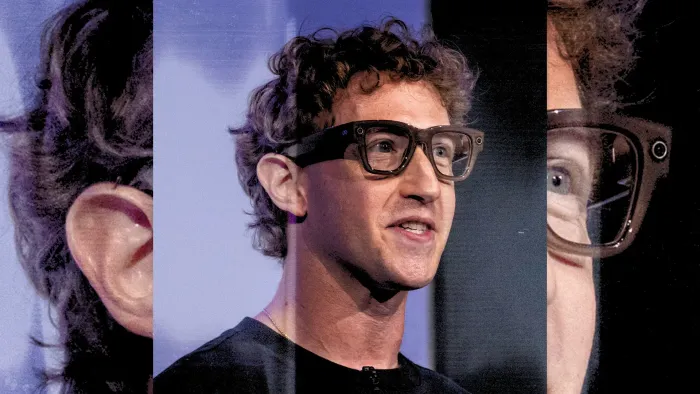
To the latter point, the chief executive said he believes AI-powered smart glasses will represent a paradigm shift in personal computing, likening the specs to the smartphone’s impact on computing, and saying glasses will be “the ultimate incarnation” of the device we use most efficiently to consume AI content.
“They’re going to be able to see what you see, hear what you hear, talk to you and help you as you go about your day, and even show you information or generate custom UI right there in your vision,” Zuckerberg stated in comments posted to Facebook.
“I think we’re at a moment similar to when smartphones arrived, and it was clearly only a matter of time until all those flip phones became smartphones,” he added. “It’s hard to imagine a world in several years where most glasses aren’t AI glasses.”
His statement here isn’t much of a surprise, however, considering how Meta has long worked on devices aimed at dethroning the smartphone as people’s personal computer of choice.
Meta first tried to do this with its virtual reality headsets and virtual “metaverse” world. These initiatives were run by the company’s Reality Labs division.
But early this month, Meta initiated massive layoffs at Reality Labs, and admitted that its VR product never caught on with the general public.
Any hardware that Meta makes still represents a minuscule part of Facebook’s revenues. The company is, after all, primarily an advertising company, not a hardware technology one.
Around 97% of its revenues are made from selling ads across its platforms.
Not surprisingly, Zuckerberg touched on how artificial intelligence would be a boost to its current ad business.
The Meta CEO said that it was currently working on merging its LLMs with its ads system and said that its current “world-class recommendation systems,” which its ads rely on, were still “primitive compared to what will be possible soon.”
As an example, Zuckerberg pointed out that Meta’s existing ad systems help businesses find the right, specific users who are likely to purchase their goods.
But thanks to AI, “New agentic shopping tools will allow people to find just the right very specific set of products from the businesses in our catalogue.”
It’s not the only way that Meta’s ad business stands to benefit from the artificial intelligence boom.
Meta, like many tech giants, is rushing to build out its personal data centre capacity to run artificial intelligence tools on. By owning the data centre directly, Meta and these other companies will be able to cut down on costs, which are currently paid to third-party data centre owners.
As analyst firm MoffettNathanson pointed out in a research note on Thursday, Meta’s buildup of its own data centres could benefit its business.
“[Given] the AI capacity constraint facing the industry, Meta has been forced to use third-party cloud offerings as their own data centres are not ready to move online yet,” the research firm noted. “Longer-term, these workloads should shift from 3rd party contracts to Meta’s own facilities which, we think, should produce margin leverage.”
ABOUT THE AUTHOR
Michael Grothaus is a novelist and author. His latest novel, Beautiful Shining People, has been translated into multiple languages.
This article was edited from its original publishing.
