


ENAEX AFRICA - Demonstrates How Intelligence, Inclusion, and Intention Are Rewriting the Future of Mining
Image: Supplied
In the heat and spectacle of the 2026 Mining Indaba, amid the polished presentations and the cautious optimism of commodity executives, two themes kept resurfacing: innovation and sustainability. They were not spoken of as abstractions. They were invoked as imperatives. Mining, long defined by extraction and endurance, now finds itself in an age that demands intelligence and responsibility.
One company that seemed to embody this pivot was Enaex Africa. It appears on the cover of the Brands That Matter issue of FastCompany (SA), not merely as a commercial success story, but as a case study in accelerated transformation. Its CEO, Francois Baudrand, together with his executive team, spoke with the calm conviction of leaders who believe they are redesigning more than a balance sheet. They are redesigning an industry.

Fast Company(SA) Editor- in-chief, Wesley Diphoko and Enaex Africa CEO, Francisco Baudrand
Image: Supplied
Mining has always relied on controlled explosions — moments of force designed with precision. But for decades, the intelligence surrounding those blasts lagged behind physics. Enaex’s wager was that blasting could become as data-driven as aviation.
The result is Enaex Bright, a digital ecosystem that transforms traditional blasting into an integrated information system. At its core, it is a platform that connects drilling metrics, explosive loading data, truck movements, and blast outcomes into a continuous feedback loop. Sensors, IoT instrumentation, and analytics convert what was once an isolated event into a measurable, optimizable process.
The elegance of the system lies not in spectacle, but in integration. Enaex Bright enables full traceability — from blast design to execution to performance outcomes. Variability is reduced. Productivity rises. Risks can be identified earlier. Under Baudrand’s leadership in South Africa, the platform has been customized for the geological and operational realities of African mines, where unpredictability and depth introduce layers of complexity.
Artificial intelligence, in this context, is not a buzzword. It is a tool for pattern recognition in environments where a miscalculation can have profound consequences. In deep underground mining, intelligence is safety.
Innovation rarely thrives in homogeneity. Enaex Africa’s leadership reflects a blend of deep South African experience and Chilean mining heritage — a collaboration shaped by two nations whose economies have long been tied to mineral wealth.
This cross-continental executive dynamic has translated into measurable transformation. In its first year, Enaex Africa achieved a Level 4 B-BBEE rating. It moved rapidly to Level 2 and now operates at Level 1 — a progression that remains rare in the mining sector. Such acceleration suggests not compliance, but intent.
The company’s diversity strategy is not framed as an obligation. It is framed as a strategy. A broader talent base means broader perspective. And in an industry undergoing technological reinvention, perspective is currency.
For decades, mining companies spoke of sustainability in terms of land rehabilitation and environmental compliance. Enaex’s approach widens the lens to human capital.
Through the Enaex Academy and associated leadership programmes, the company is cultivating a pipeline of blasting specialists, engineers, and future executives. The idea is straightforward: modernization requires skilled operators who understand both explosives and algorithms, both rock mechanics and robotics.
Community development and skills transfer are not peripheral activities. They are structural investments. In a sector facing both skills shortages and generational transition, the training of young South Africans becomes an act of industrial continuity.
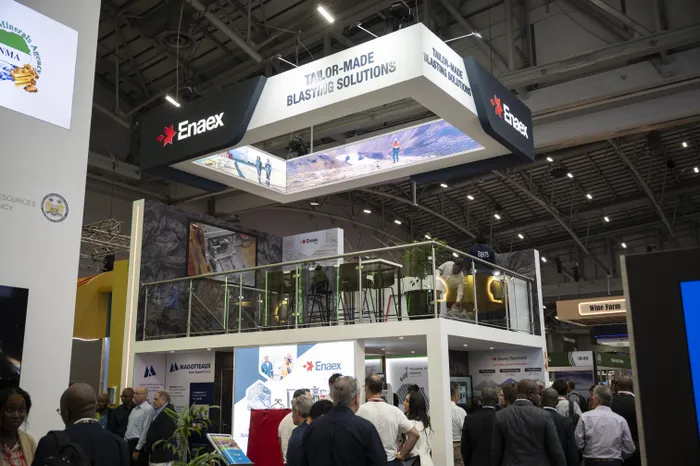
Enaex Africa's Activation at the 2026 Mining Indaba
Image: Supplied
Perhaps most telling is Enaex Africa’s partnership with Stellenbosch University. The company funds a research chair in artificial intelligence and robotics for mining — a deliberate effort to root frontier technologies within local expertise.
The goal is practical: improve safety in deep underground operations. But the implication is larger. By embedding research capacity within a South African institution, Enaex signals that innovation need not be imported. It can be cultivated.This collaboration illustrates a pattern common to industries in transition: when academia and industry align, the pace of change accelerates.
Taken together — the digitization of blasting, the multicultural executive structure, the rapid transformation credentials, the academy model, and the research partnership — a coherent narrative emerges. Under Francisco Baudrand’s leadership, Enaex Africa is positioning itself not simply as a supplier to mines, but as an architect of their modernization.
Mining is one of humanity’s oldest industries. Yet at the 2026 Indaba, it felt unmistakably new. In the controlled force of a blast, there is now code. In the leadership ranks, there is cross-continental collaboration. In the training halls, there is a new generation preparing for a different kind of shaft.
Innovation and sustainability, once conference themes, are becoming operating principles. And in that transition, Enaex Africa offers a glimpse of what mining may yet become.
