
.
Image: GERARD MALIE/AFP via Getty Images]
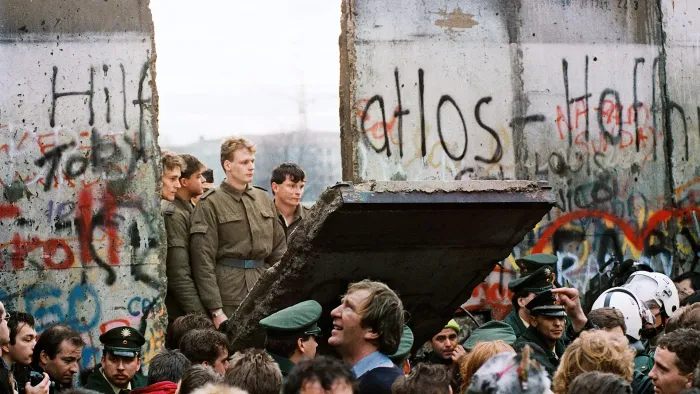
The Cold War lasted 45 agonising years. Daily life in the Soviet Union was a mixture of dread and horror—children taught to report their parents’ whispered doubts, families queuing for hours for bread, dissidents vanishing in the night. November 8, 1989, was just another day of knowing World War III might pop off at any time. But on November 9, 1989, the Berlin Wall came down. No tanks. No gun battles. No sabotage. Just a peaceful, surreal collapse.
The empire fell both slowly and suddenly. Gen Xers and boomers remember the disorienting feeling of watching the impossible happen on evening news broadcasts.
With the benefit of hindsight and declassified records now available, we know life under Soviet rule was far worse than Cold War movies or propaganda posters ever revealed. Millions suffered in silence, unable to ask for help because everyone was incentivised to spy on their neighbours.
And then, out of nowhere, Germans from East and West Berlin were blaring American rock music from boom boxes, laughing, dancing, and spray-painting graffiti. Strangers took turns smashing apart the physical barrier between despair and hope with whatever they could find—hammers, pickaxes, or bare hands.
Just because current circumstances are miserable doesn’t mean they can’t turn around. When you study history, you can’t help but be overwhelmed by how often things get better in the end—and how quickly the transformation can happen once it begins.
Cynicism can be tempting for urbanism reformers. They desperately want to break free of status quo regulations and processes that create an antihuman built environment, but it seems hopeless. And yes, the current situation for most Americans is harmful:
It feels like things have always been this way and always will be. Lack of pedestrian infrastructure, unreliable transit service, subsidised sprawl, ever-expanding arterials—it’s exhausting.
Focusing only on the negative without exploring positive outcomes is how cynicism creeps in. “They’re never going to change, because they don’t care about us.” (Whoever “they” happens to be for any given topic—city council, planners, engineers, developers, NIMBYs.)
Cynic (noun): a faultfinding critic who believes that human conduct is motivated wholly by self-interest
Cynicism feels like realism, but it’s actually a form of blindness. It prevents you from seeing the change agents working in the background, the small victories accumulating, the institutional momentum slowly, imperceptibly shifting—until suddenly, the wall comes down.
The internet is full of inspiring examples of institutional reform, from massive governments to pocket neighbourhoods. Change agents work quietly in the background for years, and then suddenly . . . liberation.
Just like world history lessons, you can’t hold onto cynicism if you allow yourself to learn about before-and-after stories related to the built environment. There’s too much evidence of reform, too many walls already crumbling, for anyone to hang their head in gloom about the future of planning and design.
The people dancing on the Berlin Wall in 1989 didn’t bring it down alone. They were the visible celebration of decades of invisible work—dissidents who wrote forbidden letters, families who maintained hope, officials who made small concessions that accumulated into structural weakness, and a few rogue journalists who told the truth despite the consequences.
You might be one of those invisible workers right now. The person who shows up to planning meetings, who writes letters, who builds tactical urbanism projects, who votes for better policy, or who simply talks to friends about what’s possible.
The wall you’re pushing against might not fall tomorrow. But if history teaches us anything, it’s that things that seem permanent can collapse with stunning speed once enough pressure accumulates. What feels impossible on a Wednesday becomes reality by Thursday.
Things get better in the end.
ABOUT THE AUTHOR
Andy Boenau is a storyteller and street fixer. He lives in Richmond, Virginia, a delightful city that will be a bicycling paradise by the time his two sons have bike-riding kids of their own.
