
.
Image: Doma
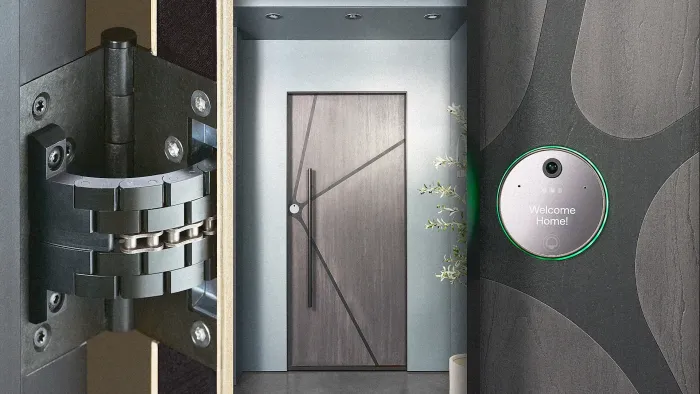
The automatic door has been reinvented. The home-focused tech startup Doma just announced its first product line: a set of residential doors capable of opening and closing automatically at the sight of an approaching homeowner.
Packed with sensors, motors, and facial recognition technology, Doma Intelligent Doors bring such functionality and programmable controls to a home’s front door—all without clunky and unsightly equipment.
.
Image: Doma
Doma is led by founders Jason Johnson and designer Yves Béhar, who previously founded and later sold the smart door-lock company August Home. The two joined forces again after sharing a frustration with the state of smart home technology. Despite more than a decade’s worth of smart home gadgets like the Nest thermostat, Ring doorbells, and robotic vacuums, the ideal of an integrated, Jetsons-esque automated home has never quite materialized.
“It’s a lot of little devices that are peppered around the outside of your home, inside of your home, but nothing that really goes from products and apps to something that’s within the walls, within the systems of the home,” Béhar says. “We decided to move forward from this notion of the smart home, which didn’t really happen, to the intelligent home.”
.
Image: Doma
Doma Intelligent Doors aim to streamline one of the most common interfaces in the residential environment. Because of how often people open and close their front doors, the process has always been manual. A relatively light lift in terms of effort, the simple act of opening and closing a door is not without its challenges. Particularly for people who are living with disabilities or limited mobility, automatic doors can be hugely beneficial. But even those who can open a door easily, a little help can sometimes be handy.
“It’s amazing how often you actually have your hands full,” Johnson says. “At least me, personally, I always have things in my hands, and it’s really nice to have the door open for you. And just as nice as that is, it’s really nice to have the door closed for you.” Doma’s goal is for this type of automation to spread throughout the home.
.
Image: Doma
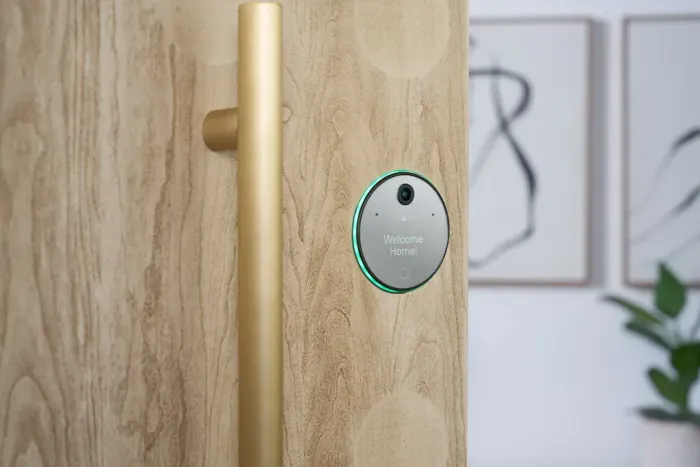
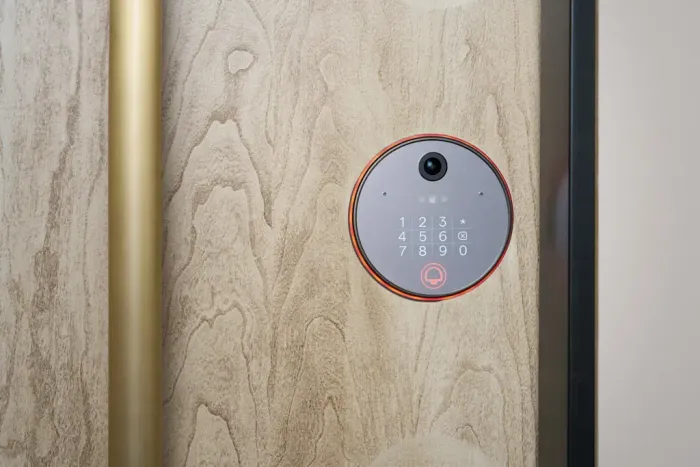
Doma’s doors work by recognizing a home’s residents and opening the door when they approach. A doorknob-size circular screen on the exterior of the door contains the facial recognition sensors that allow the door to open as a resident approaches.
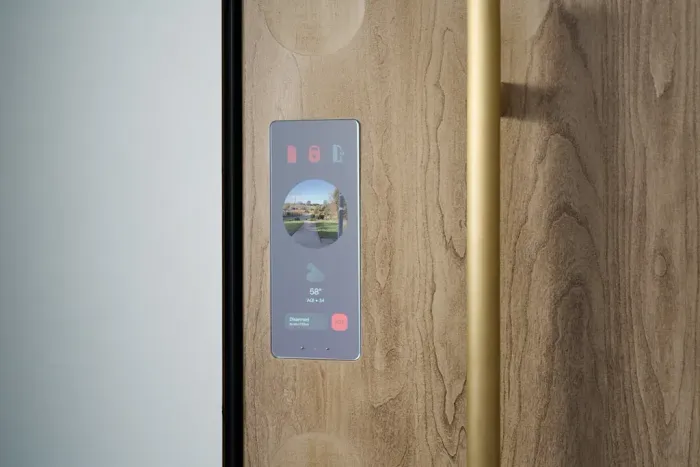
Aside from facial recognition, Doma designed the system to operate in five other ways, including Bluetooth, ultra-wideband positioning sensors, access by a scannable QR code, password access through a keypad, or via the internet. A larger screen on the interior side of the door functions as a control panel for locking, unlocking, and temporarily holding the door open, and also functions as an oversize peephole with a live video feed.
.
Image: Doma
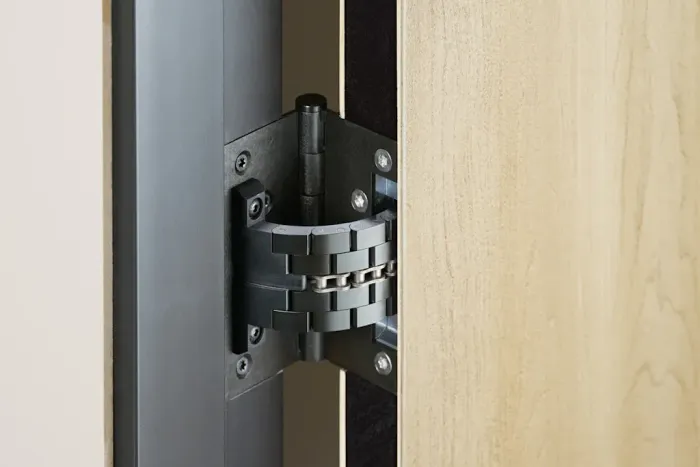
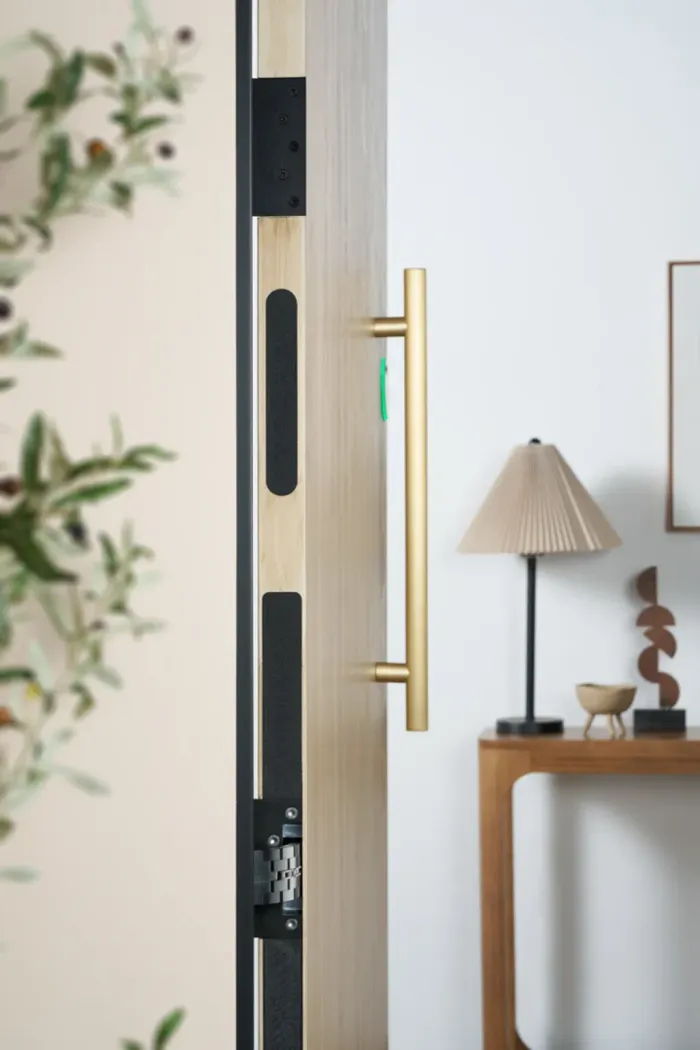
Doma’s motors and closures are integrated inside the door itself, making them compatible with conventional doorframes. On the hinge side, the closure attaches to the doorframe at a single point, and the system is hardwired into the home’s electrical system. All the door’s components, including a backup battery that can run for up to 30 days, are accessible from the edge of the door.
Johnson says this approach was part of the reason that he and Béhar started the company. They wanted, he says, “to make technology more blended into the surfaces of the home and disappear as much as possible.”
The technology behind the opening and closing of Doma’s automatic door was a key focus during the design process. “One of the things we really don’t like about existing motorized openers is when you don’t expect it to be closing. It starts closing on you, and you go to touch it and it, and you feel that motor, like it fights you,” Johnson says.
The company invented a mechanism using highly sensitive millimeter wave radar sensors that stop the door’s motor the moment it sees a human in its path. They’ve also created what they call an electronic clutch that immediately disengages the motor if the door is pulled or pushed manually. “It operates just like a normal door, without any friction or resistance,” Johnson says. “The technical term is ‘motor drag.’ We have no motor drag, and that is something we’ve filed a patent on and we’re very excited about.”
.
Image: Doma
For its automatic doors, Doma has already partnered with six major door manufacturers: Kolbe Windows & Doors, GlassCraft, MasterGrain, Doors & More, Artema, and Liberty Openings. By the time sales officially launch in summer 2026, the company expects to have another six partners to broaden its offerings. Doma claims its doors will have costs “equivalent to the price of a premium entry door, hardware and electronics purchased separately, depending on style, materials, and configuration.”
In early 2026, the company plans to announce a second product line featuring smart windows. Sales are expected to begin in the fall. Using the same open-and-close technology and a similar approach to automation and user control, the windows are seen as part of a comprehensive package for improving a home’s security, air quality, and climate control.
The idea behind Doma is that by connecting various parts of the home to these controls, the technology can automate simple but repetitive tasks, saving effort while also optimizing the interior environment. With windows and doors that can open and close on their own, Béhar and Johnson suggest, a home can react in real time to the needs of its users without their having to ask.
In conjunction, it’s a closer approximation of the kind of smart home Béhar and Johnson had in mind when they made their first smart device. “Doma really represents a shift from device-centric thinking to environment-centric thinking,” Béhar says. “So, it’s not a product you install; it’s really a living system that you inhabit.”
ABOUT THE AUTHOR
Nate Berg is a staff writer at Fast Company, where he writes about design, architecture, urban development, and industrial design. He has written for publications including The New York Times, the Los Angeles Times, The Atlantic, Wired, The Guardian, Dwell, Wallpaper, and Curbed.
