
.
Image: simplehappyart/Adobe Stock
Imagine this: One day, you won’t have to waste hours of your life doing your most arduous, least favourite forms of shopping. You know what I’m talking about—buying Christmas presents for distant aunts, getting supplies for your kid’s birthday, ordering groceries for dinner.
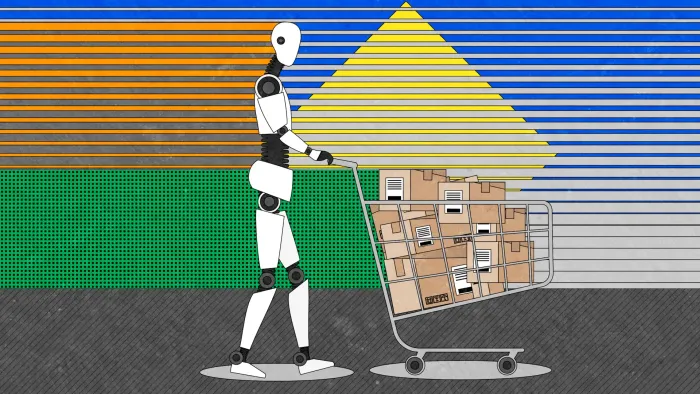
In the near future, you’ll empower your AI agent to tackle the task, then off it will go, identifying the right items, comparing prices, and—most impressively—making the purchase for you. Within hours, a tin of your aunt’s favourite biscuits, the correct number of Peppa Pig plates, and a bag of groceries will arrive at your doorstep.
We’re not quite there yet, but experts say that this future is much nearer than you think. Consumers are incorporating AI into their shopping at a meteoric pace, tapping agents to discover products and making purchases based on their suggestions. Shopify, which runs online stores for more than five million brands, has found that AI-driven traffic had grown sevenfold this year compared to last, and AI-driven purchases have increased by 11 times.
In November, Adobe determined that three-quarters of all purchases made on a computer were referred by AI, as were a quarter of those made on a phone. “The likelihood to purchase if you come from an AI source platform is higher than a non-AI source right now,” says Vivek Pandya, director of digital insights at Adobe. “That’s happened in a very short period of time.”
This spike in AI adoption suggests that 2026 is going to be a transformational year for shopping. We’re shifting away from searching for products on Google and discovering them on social media, and instead, we’re going to start our shopping journeys from within an AI system. Now, retailers and brands are scrambling to adapt to this reality, beefing up their technological capabilities for this new era. Fully autonomous buying will be here before you know it.
Since the late 1990s, shopping on the internet has followed the same script. We opened Google, typed in what we wanted to buy, then scrolled through endless rows of links before making a purchase. Finding a black cashmere sweater means scanning through rows of thumbnails—the digital equivalent of digging through an enormous bin of inventory in a backroom. “The cognitive load that the consumer has to deal with day in and day out is profound,” says Pandya. “They had to go from online store to online store, opening multiple windows.”
But this year, we realised we could offload this mental burden to AI. This was particularly true for products that require a lot of research, like an expensive gift, or a lot of planning, like supplies for a party. We describe our criteria to an agent listing our budget, style, and constrains, then let it generate ideas and compare products. In other words, it’s much more like the experience of visiting a department store and having a well-trained retail associate advise us on what to buy.
According to Adobe’s analytics—which tracks more than a trillion visits across sites—it’s not that AI is referring us to products and retailers. It’s also that AI-driven traffic leads to higher levels of conversion and more time on a brand’s website than traffic coming from a Google search or social media. In other words, AI isn’t just sending clicks; it’s sending shoppers who already know what they want and are ready to shop. “People are bouncing off less once they hit the retailer’s websites when they came from an AI source, and they're spending more time exploring pages,” Pandya says.
Vanessa Lee, Shopify’s VP of Product, agrees with Pandya that this sudden shift in consumer behaviour is going to reshape the retail landscape very quickly. And the faster retailers and brands are able to adapt to AI, the more likely they are to thrive in the years to come. But retailers are taking very different approaches to AI. Walmart, for instance, partnered with OpenAI in October to make it possible for people to shop directly from ChatGPT.
Amazon, conversely, has decided to block AI agents from crawling its website so that links don’t appear in searches, because it believes that these platforms degrade the shopping experience. In a cease and desist letter from October demanding that Perplexity stop using its data, Amazon pointed out that agents may not provide the best price, delivery method, and recommendations that Amazon itself would provide.
Shopify, one of the biggest e-commerce players on the market, has made the decision to go all in on AI on behalf of its five million merchants. This will be transformative, because it serves a wide range of companies, from tiny local shops to digitally native startups like Allbirds and Glossier, to big names like Mattel and Nestlé. Earlier this year, Shopify CEO Tobi Lütke said that the company was mandating an AI-first strategy, explaining that using AI is now a “fundamental expectation of everyone at Shopify.”
For two years, Shopify has deployed AI to help merchants on the backend to build and run their stores. In 2023, it launched Shopify Magic, an AI-powered tool that would generate product descriptions and marketing content. Last year, it launched Sidekick, an AI assistant that helps merchants with complex tasks like creating discount codes and analysing sales trends. And this year, it deployed AI Store Builder, which lets merchants generate fully formed online stores from keyword prompts. It also acquired Vantage Discover, an AI search company that provides more personalised, context-aware results when a customer searches for a product on the merchant’s website.
Shopify is betting that consumers will increasingly begin their shopping journey on an AI agent, so it’s important for their brands to be easily searchable by AI. How do they do this? According to Pandya, the quality of data on a merchant’s site influences whether the agent will recommend a product. “Deep, rich, authoritative information helps the agent feel comfortable recommending one result over another,” he says.
This is why Shopify has been working with merchants to ensure that the data on their sites will show up in AI queries. This year, the company introduced Agentic Storefronts, which make merchants’ product catalogues discoverable inside AI chats like ChatGPT and Perplexity. Depending on the query and how much detail the consumer is searching for, the response will simply surface a product link; in others, the response will surface “cards” that provide a thumbnail image, a brief description, and a link.
Lee points out that shoppers also want to know that the results that the AI is providing are trustworthy. So Shopify has worked with all the major agents to ensure that products come with a citation from the brand’s website, much like the AI might cite a book or a magazine. “Citations matter,” she says. “Consumers want to know where a fact came from.”
But perhaps Shopify’s most powerful new tool, says Lee, is OpenAI Instant Checkout, which launched in September. It allows customers to shop directly from ChatGPT without leaving the conversation. Right now you can only buy a single item at a time through this system (like say, paper plates), but soon, you’ll be able to put several items in a cart over the course of a conversation (like balloons and a tablecloth) then buy them all at once. Merchants need to opt in to this technology, and already more than a million of them are using it. “We want merchants to be in the control seat,” Lee says.
Shopify’s checkout tool offers a glimpse into the future—to a time when fully autonomous shopping may become the norm.
For now, Lee says there are two obstacles to this. There’s the technical challenge of creating the infrastructure and safety precautions to allow an agent to shop on a user’s behalf. This will mean everything from partnering with payment companies to establishing the legal basis whereby a consumer empowers an agent to make purchases they did not approve beforehand.
There’s also the fact that consumers aren’t quite ready to trust an agent to make the right decisions, especially when it comes to matters of individual taste, and especially if it has access to your credit card. “Consumers still want to stay in control,” says Lee.
All of this is changing, and quickly, Lee says. Shopify is already working on many tools that will make buying easier from within an agent. The company has a lot of experience making shopping more seamless. In 2017, it launched Shop Pay, which allows consumers to save their payment and shipping information so they can use it across Shopify merchants. To keep these transactions secure, it has leaned heavily into Apple Pay and Google Pay, which consumers trust to store their credit card information. Shopify is already working to incorporate a similar system into AI agents.
Lee says that Shopify and other online platforms like Apple and Google took a long time to build trust with consumers, so that they feel comfortable sharing their payment information. But the next frontier is feeling comfortable enough to let a third party actually make purchases on your behalf. Right now, consumers expect to confirm their purchase. “We still think the verification screen is important for both consumers and merchants,” she says.
But change is happening quickly. People already trust AI to help them do many things in their life, from making parenting decisions to doing aspects of their job. And there are many forms of shopping that consumers wish they could hand off to an assistant. So it may not be long before we let our AI agent handle these pesky tasks.
ABOUT THE AUTHOR
Elizabeth Segran has been a staff writer at Fast Company since 2014. She covers fashion, retail, and sustainability. She has interviewed Virgil Abloh, Mara Hoffman, Telfar, Diane von Furstenberg, and Ulla Johnson, among many other designers
FAST COMPANY