
.
Image: Courtesy of LEGO® Education
Most adults are in the very early stages of grasping how to use artificial intelligence. The Lego Group thinks that children need to build their own learning path to understand the fast-evolving technology.
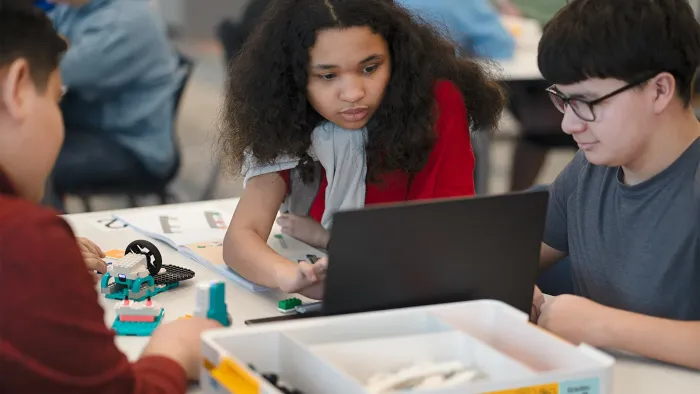
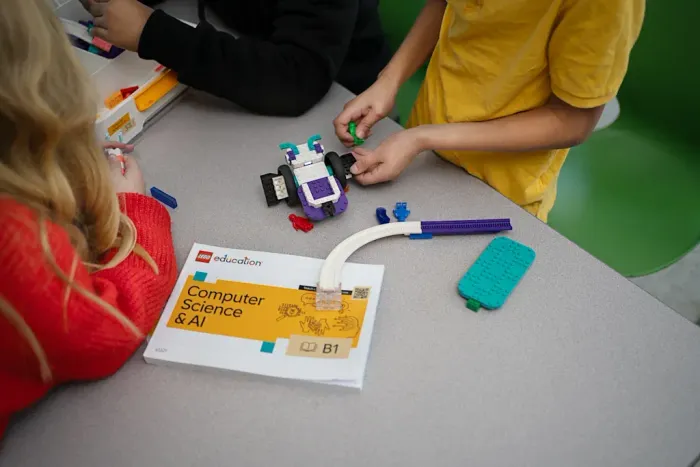
On Monday, the Danish toy maker debuted a new computer science and AI curriculum for K–8 classrooms, Lego’s first foray into AI that comes more than three years after the debut of OpenAI’s ChatGPT chatbot. The Lego Education Computer Science & AI kits include Lego bricks and other interactive hardware components, as well as online education materials intended to take children from the beginning stages of AI literacy through hands-on experimentation.
Debuting in classrooms this April, Lego says each package will cost $339.95 and is designed for groups of four students.
Lego says 90% of kids want to learn more about how to use AI, but two-thirds feel left out of the AI conversation, according to a survey of 800 students ages 8 to 14 across the U.S., Germany, South Korea, and Australia conducted in late 2025.
“Children have their own thoughts on how AI should be used, or how it shouldn’t be used,” says Andrew Sliwinski, head of product experience of Lego Education. “Let’s bring children into the conversation in an informed and empowered way.”
The curriculum will be sold in three grade bands—K–2, 3–5, and 6–8—and was designed as an end-to-end program for teaching both computer science fundamentals and AI concepts. According to Sliwinski, no data children share ever leaves the computer. The system works offline, and no private information is sent to Lego or any third party.
.
Image: Courtesy of LEGO® Education
Sliwinski says Lego wanted to move past the two dominant narratives around AI and children. One frames AI as an unstoppable force that will render kids obsolete before adulthood. The other calls for strict bans that prevent children from interacting with the technology at all.
“What both of those narratives are often missing is that children are capable,” he says. “They have their own opinions and thoughts on AI and how it should and shouldn’t be used.”
The broader toy industry is still fumbling its approach to artificial intelligence. Mattel failed to deliver an AI-powered toy in 2025 under its partnership with OpenAI. Another AI-enabled teddy bear was banned after it engaged in sexually explicit conversations with minors.
In California, a state senator has introduced a bill that would enact a four-year ban on AI chatbot toys for children under 18.
“I would never suggest buying a toy that has AI embedded in it,” says Rebecca Winthrop, a senior fellow at the Brookings Institution. “It is just way too soon.”
Still, Winthrop argues that banning AI in schools is unrealistic. Students will find workarounds, and many already encounter AI passively through everyday apps.
If AI can write a seventh-grade paper on World War II, students lose the critical thinking that comes from doing the work themselves, Winthrop says. That means educators will need to redesign assignments so the process—not just the output—matters.
“Teachers are really going to have to shift the assignments they give,” she says.
Justin Reich, an associate professor at MIT, says schools will need to operate under uncertainty for years. No one knows exactly what a 5-year-old should understand about AI—but waiting for perfect answers isn’t an option.
“We’re almost certainly making mistakes,” Reich says, likening the moment to early internet literacy efforts that later proved flawed.
Sliwinski says the payoff becomes clear in the classroom. During a recent visit to a fourth-grade class in Chicago, students trained Lego-based robots to dance using a machine-learning model. When commands were off, the robots lost their rhythm.
“That creates a shift in power dynamics,” Sliwinski says. “AI is no longer the smartest thing in the room—the kids are.”
ABOUT THE AUTHOR
John Kell is a New York-based freelance writer, covering consumer trends, technology, leadership, and sustainability. He is particularly interested in how business leaders respond to changes in culture and how they position their businesses for growth in a fast-changing world.
FAST COMPANY