

Jenette McCurdy
Image: Victoria Stevens
In 2022, Jennette McCurdy released her memoir I’m Glad My Mom Died, a brutally honest portrait of her life as a former child star, her battle with eating disorders, and, as the title would suggest, her rather complicated relationship with her mother.
The book has spent more than 80 weeks on the New York Times bestseller list with over three million copies sold. It’s currently being adapted into an Apple TV+ series with Jennifer Aniston playing McCurdy’s mom, and McCurdy serving as co-writer, co-executive producer, and co-showrunner.
Adjacent to the massive success of I’m Glad My Mom Died has been McCurdy reclaiming writing, not acting, as her true passion. In her memoir, McCurdy stated her acting career was solely to appease her mother and support her family, an experience she’d later describe as “hellish” and “embarrassing.”
But writing is McCurdy’s truth “North Star” for her creativity.
“Writing has always been in my bones,” McCurdy says in the latest episode of Fast Company‘s podcast Creative Control. “It’s always been my mode of processing and making sense of the world.”
And there’s much to process with McCurdy’s debut work of fiction, Half His Age.
Half His Age follows Waldo, a 17 year old high school student who enters into an affair with her married English teacher, Mr. Korgy. It’s an unflinching and often visceral exploration of power dynamics, desire, and, most of all, to McCurdy, “female rage.”
“That’s what I really tried to explore as thoroughly as I could and as potently as I could,” McCurdy says. “To me, there’s no vessel that’s more potent than a 17-year-old. Feelings are never going to be higher, never gonna be hotter, never gonna be more intense.”
In this episode of Creative Control, McCurdy unpacks her writing process (it’s a full-body endeavor, mind you), the discomfort she’s intentionally leaning into with Half His Age, and what it means to take full authorship—and creative control—of her career.
NOTE: Some spoilers ahead!
The initial idea for Half His Age came to McCurdy nearly a decade ago. She knew she wanted to explore a relationship between a young girl and her teacher, but that was about it. It wasn’t until around two years ago, as she was trying to write something else, that Half His Age kept bubbling up.
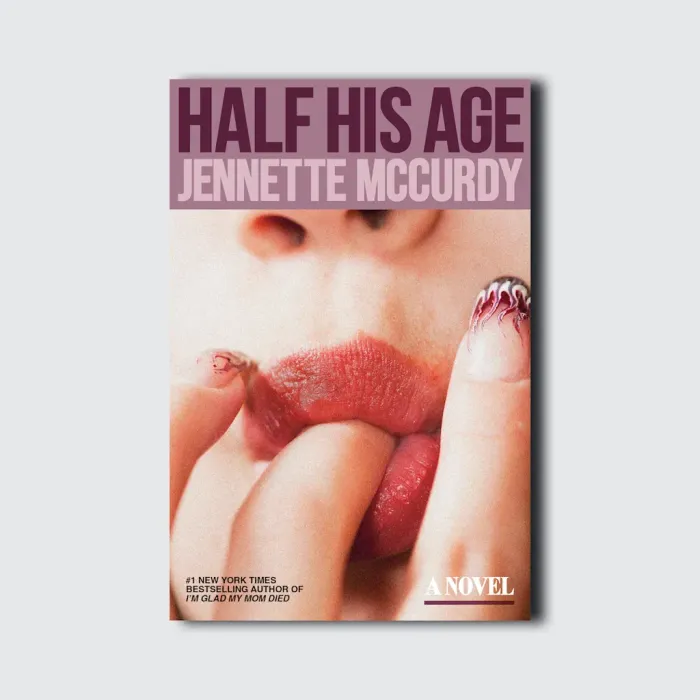
.
Image: Cover Image: Random House
“It was keeping me up at night, frankly. I couldn’t stop thinking about it,” McCurdy says. “I said, I’m going to give Half His Age a week; I’ll grow tired of it by day three or four; and it will never come to fruition.”
Cut to McCurdy going all-in to write her first draft in a month.
“I’m such a full bodied writer. I write with emotions. For my first drafts, my inner critic is nowhere to be found,” McCurdy says. “That’s generally how I know. If I’m feeling really emotionally activated by an idea, that’s my sign it’s go time—I’m so sorry for saying, ‘it’s go time.’”
The premise alone of Half His Age could be enough to negate a whole swath of potential readers. The concept of a high schooler entering into a sexual relationship with her teacher is most certainly squirm-worthy. Adding to that is the highly visceral nature of how McCurdy explores this affair and the collateral emotional damage it inevitably brings.
One scene in particular involves Waldo and Mr. Korgy having sex while she’s on her period. Midway through, they’re interrupted and Waldo is forced to hide in a closet while she continues to have her period holding her blood in her hands.
“I think it’s a very memorable [scene]. I did want it to feel very visceral and just deeply uncomfortable,” McCurdy says. “It was important that Waldo experienced something so raw and so ugly because she needed some kind of wake-up call, some kind of rock bottom that could help her piece things together.”Broadly speaking, the discomfort in Half His Age is driven by something more universal than cupping your own period blood in a closet. Much of the novel feels like a mediation on gaining autonomy over your own body.
“At that young age, you don’t know what [your body] wants,” McCurdy says. “It’s just this complicated process of fully integrating your mind and your body.”
“As a woman, so much of our intuition, so much of my intuition, comes from my body and me sitting with it,” she adds. “And [that’s] for better or worse. Sometimes I’m having feelings that I wish I wasn’t having. But always it’s useful information. And that’s definitely a part of Waldo’s experience throughout the course of the book and her journey.”
For so much of McCurdy’s early years, control wasn’t part of her vocabulary. In addition to being pushed into an acting career she didn’t want, McCurdy recounted stories in her memoir like her mom showering her until she was 18 years old. Fast-forward to today, McCurdy is defining her life and work on her terms—although she admits to avoiding the word “control.”
“I think I have maybe a slightly negative connotation around control. Not completely, but there’s something in it that feels a bit like grippy,” McCurdy says. “I kind of prefer the word authority.”
So how does she define authority at this stage in her life?
“When I feel authority, it’s when I allow myself to lead with my body. It’s when I listen to my body, when I take the information that’s it’s giving me, and I sit with it,” McCurdy says. “For so much of my life, I neglected the cues and the emotions and all that my body was telling me. And now I think, you know what? My body has wisdom that I don’t got.”
ABOUT THE AUTHOR
Kc Ifeanyi is the executive director of editorial programming at Fast Company. In his role, he leads the magazine's live event content across strategizing and executing stage programming and editorial coverage.