

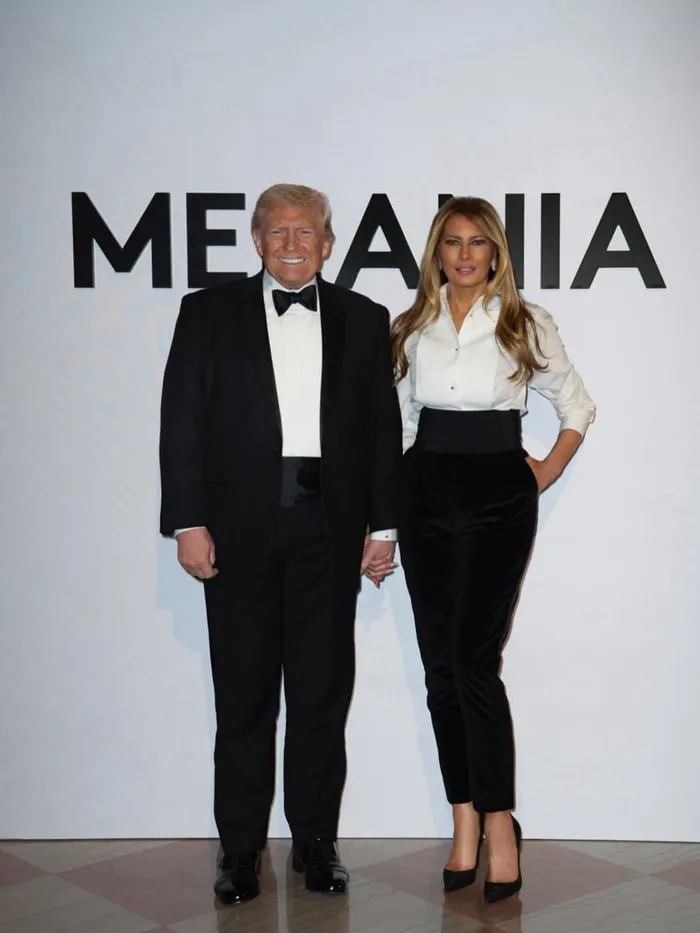
US president Donald Trump with his wife, Melania Trump at the premiere of her new documentary "Melania".
Image: Instagram.
When Melania: Twenty Days to History hit cinemas in late January, expectations were low, hype was high, and the reaction, predictably, polarised.
According to Fox News, the film was backed by a reported $75 million (R1.43 billion) overall spend, the most ever associated with a documentary.
The film’s performance has sparked a debate about what “success” really means in the documentary business.
Despite early predictions that the film would struggle to open above $3–5 million (R57m–R95m), Melania debuted with roughly $7 million (R133 million) at the US box office, screening in close to 1,800 theatres.
By documentary standards, that opening is significant. It marks the strongest opening for a non-concert documentary in nearly a decade, outperforming recent nonfiction releases that typically debut well below $5 million (R95 million).
Yet the context matters. The theatrical revenue represents only a fraction of the film’s total cost.
Much of the media narrative labelled the film a box-office failure. That framing is technically accurate if the comparison is made to mainstream Hollywood releases or to the scale of its investment.
Amazon MGM reportedly paid around $40 million (R760 million) for the global rights, with an additional $35 million (R665 million) spent on marketing.
Against that outlay, a R133 million opening weekend does not come close to breakeven.
However, by documentary economics, Melania did not collapse. Most feature-length documentaries never receive wide theatrical releases and often struggle to cross R20–R40 million in total box-office earnings. From that perspective, calling the film a “bomb” oversimplifies the picture.
Typical documentaries: Many open below $1–2 million (R19m–R38m), often without national theatrical exposure, according to Forbes.
Recent high-performing docs: Films like After Death opened around $5 million (R95 million) — still below Melania’s debut.
Outliers: Concert documentaries and cultural phenomena, such as Taylor Swift’s Eras Tour, operate in a different financial universe and are generally excluded from traditional documentary comparisons.
Measured strictly within its category, Melania ranks as a commercially strong release, even if it falls far short of recouping its unprecedented costs, according to Screen Daily.
While exhibitors and distributors face a long road to profitability, Melania Trump herself is already in the black.
Industry reports suggest she received up to 70% of the rights deal, translating to an estimated $28 million (R532 million) payout.
That income is independent of box-office performance, meaning the former First Lady profited handsomely regardless of ticket sales.
Amazon MGM, on the other hand, is betting on longer-term value through streaming, international licensing, and political-cultural relevance rather than theatrical returns alone, as reported by the Hollywood Reporter.
The conflicting headlines, “bombed at the box office” versus “record-setting documentary opening,” reflect two different lenses:
Cultural commentary focuses on empty seats, harsh reviews, and the optics of a billion-rand documentary failing to dominate cinemas. Industry analysis points to a nonfiction film outperforming nearly all recent peers in its genre.
The reality sits squarely between the extremes.
Melania was not a blockbuster, nor was it a theatrical disaster. It was a commercially strong documentary release with an unsustainably large budget, a reminder that in the documentary business, success is always relative, and balance matters more than headlines.
FAST COMPANY (SA)
