

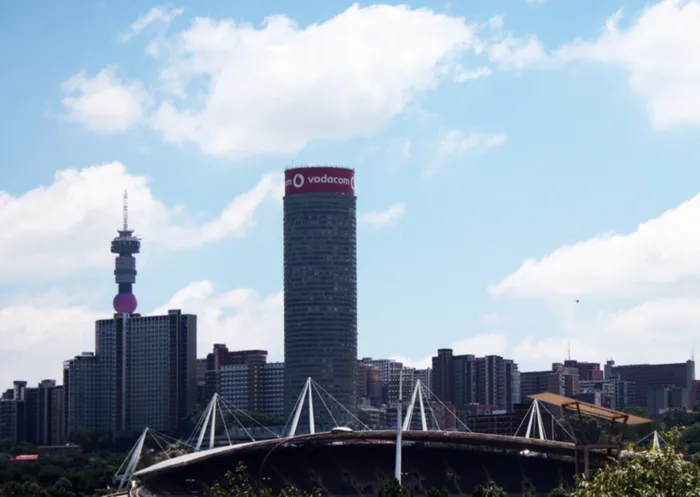
The Telkom Towers, a building that has cost the state nearly R1 billion, remain unusable.
Image: File
For decades, South Africa has owned a large property portfolio in the country, yet too many assets stand vacant, vandalised, hijacked or underused.
At the same time, the state spends up to R6 billion every year leasing private buildings, says Minister of Public Works & Infrastructure, Dean Macpherson, during parliament’s State of the Nation Address (Sona).
“We own prime property that stands vacant. Yet we pay rent for plush offices. We hold strategic land parcels in the metros while people live in informal settlements. We sit on an enormous asset value base, yet we don’t generate any revenue to fund asset maintenance,” Macpherson says.
These contradictions end here, the minister adds.
“The truth is: the current model was never designed to build value, making reinvestment in maintenance and upgrades almost impossible. The result is predictable: decay, inefficiency and lost opportunity.”
The minister says the property investment vehicle announced by President Cyril Ramaphosa at Sona last week changes that logic entirely and flips the script on unrealised property asset values, maintenance and investment.
Macpherson says work on this reform began more than a year ago, learning from best practices both domestically and internationally to create an asset book that generates wealth for the public for generations to come.
“Let me be clear about what this vehicle actually is. It is a ring-fenced, professionally governed investment platform that consolidates income-generating and strategically located assets into a single structure with one mandate: unlock value for reinvestment.
“It introduces the best in asset management, development finance and property development. It establishes a verified, digitised asset register: a single source of truth covering ownership, condition, leases, valuation and performance.”
For the first time, the state will manage its property portfolio with real-time data, not fragmented spreadsheets, Macpherson says.
“It separates the roles of owner, manager and developer: introducing professional property management expertise to run leases, maintenance of assets, lifecycle planning and tenant performance with commercial discipline, while building book asset value.
“It creates structured, long-term development rights that allow private capital to invest in precinct upgrades, mixed-use housing and redevelopment.”
Earlier this week, the City of Cape Town said in a media statement that its release of the iconic Good Hope Centre precinct for redevelopment is a strategic move aimed at unlocking its immense economic potential, revitalising the broader precinct, and leveraging private-sector investment to boost job creation and economic growth to benefit Cape Town residents.
According to Macpherson, the vehicle reforms the revenue model to generate income from these assets to support maintenance.
This is how we move from reactive maintenance to planned lifecycle management, he says.
“This is how we reduce the billions currently spent on leases. This is how property stops being a liability and starts being an asset.”
He says the vehicle includes a dedicated development capability, funding bulk services and precinct preparation so underutilised land becomes bankable projects.
Clear project pipelines will allow private sector partners and sovereign funds to participate with certainty.
In Tshwane, Macpherson says the Government precinct Programme shows what this platform makes possible: 30 projects, more than one million square metres of development, and roughly R33 billion in Phase 1 - transforming lease payments into appreciating assets.
He says Phase 1, on its own, can eliminate over R400 million in annual lease costs and deliver a portfolio valued between R45 billion and R55 billion once complete, strengthening the public balance sheet instead of draining it.
Phase 2 expands this momentum as it focuses on the refurbishment of under‑utilised public buildings, bringing them back to life as productive assets and acting as a catalyst for deeper urban regeneration.
“It also means jobs. Across the delivery cycle, nearly 100,000 direct construction and indirect jobs are projected, with up to R60 billion in broader urban economic activity catalysed in the process.”
It means well-located public land in the Johannesburg inner city being used for housing close to transport and employment, not standing fenced off or unlawfully occupied, says the Minister.
He says it also means hundreds of residential properties being offered to those who serve communities, including nurses, police officers and teachers.
“The state does not need to own all these assets, and neither should it. The DA fundamentally believes in using state assets to build generational wealth through houses that families can call their own. No longer will these homes stand idle while those who serve our country struggle for accommodation.”
He says, considering the Telkom Towers: a building that has cost the state close to R1 billion yet remains unusable. “We are finalising a Request for Information to convert this dead asset into productive accommodation for government departments.
“Consider Youngsfield and Wingfield: prime, underutilised defence land with the potential to create new communities while lowering maintenance costs, restoring dignity and bringing them closer to economic opportunities.”
Without an asset management structure, opportunities like this are never realised, Macpherson says.
He says under the structure, they become housing and mixed-use development nodes for the next generation of homeowners. “This is the difference between passive ownership and active management.”
The DPWI minister says this new investment vehicle will attract untapped investment. He says it will create hundreds of thousands of new jobs, on top of the 160 000 new jobs that were created in the construction sector over the last 6 months.
While central business districts (CBDs) used to be areas primarily focused on commercial uses, this is changing globally.
The long-term objective of the country should be the creation of a built environment that meets the requirements of different income and age groups, Emeritus Professor Francois Viruly, formerly with the Department of Construction Economics & Management at the University of Cape Town (UCT).
He says that in the future CBDs will be places offering a broader mixed-use experience, which combines home, work and play.
FAST COMPANY (SA)
