

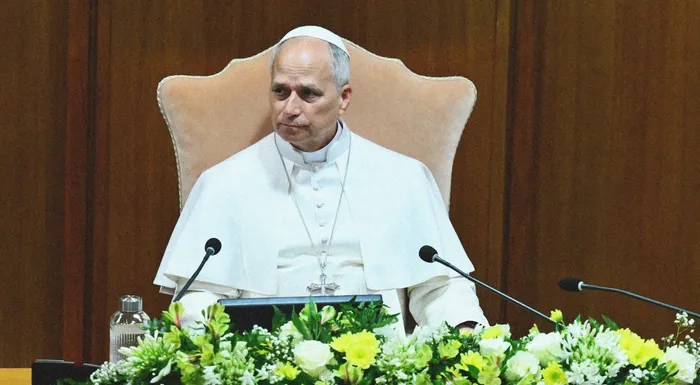
Pope Leo XIV attends the presentation of his first encyclical letter, “Magnifica Humanitas,” focused on the rise of artificial intelligence, at the Vatican on May 25, 2026.
Image: Photo: Alberto Pizzoli/AFP via Getty Images
A day after Pope Leo XIV released his much anticipated encyclical on AI, the response from the AI community has been mainly positive, with some quibbling over the nature and potential of the technology.
The Vatican released the encyclical, titled Magnifica Humanitas: On Safeguarding the Human Person in the Time of Artificial Intelligence, in Vatican City on Monday. (An encyclical is a high-importance teaching document issued by the pope.) Broadly, the document aims to demarcate the fundamental differences between humans and machines and warn about the dangers of allowing AI to be controlled and distributed by a small group of people.
The pope denounced the “culture of power” driving the AI race, referencing the small set of wealthy investors and tech companies currently controlling the development and distribution of the technology.
Pope Leo’s concerns also reflect a much broader religious debate around AI that has emerged across faith traditions in recent years. Religious leaders and scholars from Christianity, Judaism, Islam, and Buddhism have wrestled with everything from AI-written sermons and chatbot theologians to the technology’s impact on labor, misinformation, warfare, and the environment.
While some communities have embraced AI tools for research:
Within the AI research community, the response to Magnifica Humanitas has been mainly positive.
One researcher, Chris Olah, participated in the Vatican’s process of shaping the ideas behind the encyclical. “This clearly raises questions beyond computer science,” Olah said in a companion statement to Magnifica Humanitas. “
The machinery that makes this possible is the work of math and programming and science. But what character we choose, how it interacts with the world, how it ought to interact with the world—these are more clearly questions for the humanities, for religion, for philosophy, for society at large.”
The encyclical, which is 85 pages long, was informed by extensive conversations with scientists, engineers, educators, political leaders, and families, the Vatican said.
Author and systems architect Daniel Jeffries broadly agreed on X with the pope’s warning that AI reflects the values of those who control it. “The Pope is right: AI takes on the characteristics of those who build it, finance it, and regulate it,”
Jeffries wrote, before arguing that concentrated corporate control over AI could create “digital oligarchies” resembling modern-day East India Companies. AI pioneer and Turing Award winner Yann LeCun retweeted Jeffries’ post.
Another Turing Award winner, Yoshua Bengio, echoed the pope’s concern over AI’s potentially destructive power. “Like nuclear energy, AI must be at the service of all and of the common good. Decisions about technology must never be separated from conscience and responsibility.”
Not everyone in the AI community agrees with the Vatican’s view of AI's potential.The encyclical draws a firm distinction between AI systems and human beings, arguing that machines cannot possess consciousness, morality, or lived experience.
“So-called artificial intelligences do not undergo experiences, do not possess a body, do not feel joy or pain, do not mature through relationships, and do not know from within what love, work, friendship, or responsibility mean,” the document states.
AI commentator Zvi Mowshowitz took issue with that premise. “The central claim, wherein Pope Leo denies that AIs can think or importantly be minds, is wrong, as Olah points out in his statements,” Mowshowitz wrote on Substack. “Without the understanding of what AI is capable of becoming, the document effectively only deals with relatively mundane AI dangers and changes, although that on its own is still rather quite a lot to deal with and discuss.
”AI policy analyst and writer Dean Ball says the church should focus on helping humans flourish as AI evolves further. “Some think I want the Pope to ‘ensoul’ AI or acknowledge AI feelings. I don’t,” Ball posted on X.
“What I want is for the Church to contemplate what ‘humans’ should do as we are eclipsed as the smartest entities on the planet, at least for many reasonable people’s definitions of the word ‘smart.’”
President Donald Trump has yet to post about the encyclical on Truth Social, but his former AI “czar,” David Sacks, weighed in. Sacks isn’t worried about letting a small set of AI companies effectively regulate themselves; he’s worried about giving the government the power to do it. (And who can pass up a couple of literary and historical knowledge flexes when the opportunity presents? Not Sacks.)
Writing on X, Sacks argued that giving governments broad authority over AI in the name of safety could ultimately enable censorship, surveillance, and social control.
Invoking both George Orwell and the Latin phrase “Quis custodiet ipsos custodes” (translation: “Who will guard the guardians?”), Sacks wrote that “the oldest questions of human nature and authority don’t disappear in the AI age. They become newly relevant.”
In response to Sacks’s X post, a number of prominent voices in the AI world have since weighed in. Among them were Hugging Face CEO Clem Delangue, who argued that “the most important AI risk is concentration,” and cognitive scientist Gary Marcus, who warned against “leaving unelected private companies the ability to censor, surveil, and control citizens.”
The Trump administration, influenced by tech nouveau right figures like Sacks and Marc Andreessen, has gone to great lengths to keep the AI industry free of government oversight and regulation.
Notably, most of the tech nouveau right crowd has remained silent on the pope’s treatise. There have been no public comments yet from Elon Musk, Andreessen, Palmer Luckey, Balaji Srinivasan, Keith Rabois, Joe Lonsdale, or Jason Calacanis.
ABOUT THE AUTHOR
Mark Sullivan is a San Francisco-based senior writer at Fast Company who focuses on chronicling the advance of artificial intelligence and its effects on business and culture. He’s interviewed luminaries from the emerging space including former Google CEO Eric Schmidt, Microsoft’s Mustafa Suleyman, and OpenAI’s Brad Lightcap.
Original article was posted on FAST COMPANY US
