

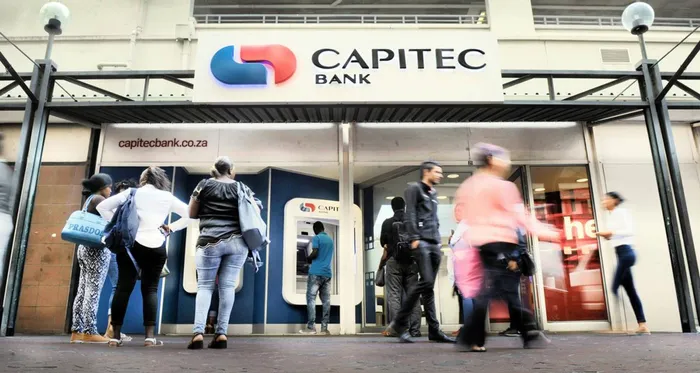
Capitec Bank.
Image: Armand Hough
In December 2025, Capitec quietly sealed a deal to acquire 100% of Walletdoc Holdings, a fintech specialising in payment-gateway solutions for up to R400 million.
Under the deal, Capitec pays R300 million upfront, with a deferred earn-out of R100 million over three years, tied to performance milestones.
Walletdoc, founded in 2015, offers scalable payment infrastructure for merchants: online and in-app payments, digital wallets, instant EFTs, payment links and real-time merchant payouts.
For Capitec, the acquisition represents more than just adding a service, it’s part of a broader push to build a full-fledged digital payments and business-services ecosystem.
The bank said the move supports its goal to lower transaction costs, expand access to digital financial services, and foster inclusion across South Africa.
But is Capitec becoming a fintech and not staying just a retail bank?
This isn’t Capitec’s first foray beyond traditional retail banking.
Earlier this year, it integrated fintech startup Stub, an accounting and bookkeeping platform enabling real-time bookkeeping and reconciliation directly for SME clients.
It seems that the bank is positioning itself not just as a financial institution, but as a one-stop platform for everything from payments to bookkeeping for small and micro businesses.
Capitec’s acquisition of Walletdoc comes at a moment when many South African banks are doubling down on fintech, the broader financial sector’s fintech buying spree surpassed R7 billion this year alone.
But for Capitec, this is not just a race to expand services, it’s a transformation of identity.
The bank seems to be evolving into a hybrid: part traditional bank, part digital infrastructure provider, part business-services platform.
By internalising fintech capabilities, Capitec can rapidly deploy new tools across its large base of personal and business clients, something many independent start-ups struggle to scale.
In its statement announcing the Walletdoc deal, Capitec explicitly framed the acquisition as a step toward building a “world-class payments ecosystem” serving its 25 million personal and business banking clients.
The implications of Capitec’s strategy extend beyond its own balance sheet.
The bank’s consolidation-first approach could be straining South Africa’s fintech startup ecosystem.
By swallowing successful fintechs, Capitec reduces the number of independent players in the market.
That consolidation can stifle competition and limit diversity in innovation.
Whereas fintech start-ups often reflect creative, niche ideas, tailored for specific pain points a giant like Capitec may prioritise scale and standardisation over experimentation.
Moreover, for entrepreneurs hoping to build lasting, standalone companies, the bar keeps rising.
With dominant incumbents absorbing the most promising start-ups, smaller and newer ventures will need deep pockets or clear differentiation to survive, a steep climb in a consolidating market.
Capitec’s current trajectory offers a preview of what “banking + fintech + business services” can look like in South Africa.
If the integration succeeds, we may see a future where traditional banking becomes less about loans and savings, and more about offering a full-stack platform for commerce, payments, and business operations.
The natural question then becomes: will Capitec’s dominance crowd out innovation, or will it raise the bar, forcing start-ups to evolve and specialise?
For regulators, investors, and entrepreneurs, the upcoming months and years will be critical.
If Capitec continues to absorb promising fintechs, it could reshape the competitive landscape, not just in banking, but in fintech, SME services, and digital commerce across the country.
