
.
Image: Smith Collection/Gado / Contributor/Getty Images
Late last week, OpenAI released the company’s new GPT-5.2 model.
If you’re a coder or someone who follows AI benchmarks for fun (hey, I won’t judge), this model will excite you tremendously.
For everyone else, prepare to be underwhelmed—or rather, prepare to wait another month or so for the real OpenAI new release to come out.
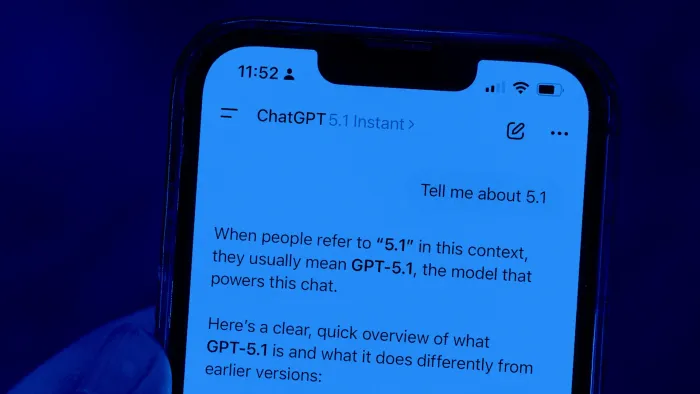
GPT-5.2 is fundamentally about making small tweaks and improvements to the already fairly new GPT-5.1 model.
Today’s release improves OpenAI’s performance on a variety of industry benchmarks. GPT-5.2 is faster and more efficient than its predecessor, and it does a better job solving scientific and technical problems.
In particular, it’s better at writing code and doing math, and performs better on so-called agentic tasks, where the model operates for a long time without human input.
OpenAI also says it’s better at solving real-world financial challenges. If it had existed when I did my ChatGPT investing experiment, maybe I really would have Lambo money by now!
Beyond that, there’s nothing especially revolutionary in GPT-5.2.
So, why make a big fuss about releasing a whole new model before the holidays if it does fairly little that’s truly new?
Because in the ongoing saga of the AI wars, OpenAI feels it needs to keep up with the Joneses—or in this case, specifically, to keep up with Google.
Industry watchers have noted that Google’s Gemini 3 model began to threaten GPT-5.1’s spot on the kind of performance leaderboards that AI companies pay close attention to.
This reportedly caused a “code red” alert from OpenAI CEO Sam Altman. Altman reportedly ordered his teams to stop working on Sora and other projects to focus all their efforts on improving ChatGPT and its underlying models as quickly as possible.
When you order a bunch of incredibly intelligent people—some of them being paid upwards of $1 million a year—to do something quickly, they’re likely to oblige. Within a few weeks of the reported “code red,” the OpenAI team had today’s incremental release ready to go.
GPT-5.2 will probably allow OpenAI to briefly leapfrog its archnemesis Google—and smaller competitor Anthropic—in industry benchmarks, once again claiming its place as the undisputed leader in the AI wars.
The “code red” reportedly isn’t over yet, though. Earlier this month, analysts noted that OpenAI was testing a new reasoning model, codenamed “Garlic.”
GPT-5.2 might have been part of Garlic. But many in the industry expect an expanded Garlic model (probably under the GPT-5.5 moniker) to come out in Q1 of 2026, potentially as early as January.
It’s likely to be a fully retrained reasoning model that brings efficiency improvements, but also genuinely impactful ones like a larger context window, new knowledge cutoff (OpenAI’s most recent models have been stuck in 2024), better personality, and improved performance on image generation to rival Google’s Nano Banana.
It’s also broadly rumoured to include a new “Adult Mode” that allows ChatGPT to engage in, ahem, “risque” conversations with users who are older than 18.
In the broader context of a potentially entirely revamped model with a January release date, today’s GPT-5.2 model feels premature.
Releasing it makes OpenAI seem a bit jumpy—like it’s nervous that someone will come along and unseat it, and is willing to go to great lengths to stop that from happening, even if everyday users barely care about coding and science benchmarks.
GPT-5.2 says less about OpenAI’s technical prowess, then, and more about how Altman and his team are feeling. Google once seemed like it was floundering and slowly losing the AI race–going the way of Polaroid or Xerox. Now, it’s back in the game and seems poised and confident.
OpenAI isn’t used to playing second fiddle. Faced with the prospect of real competition, the company is clearly getting nervous. Last year, OpenAI celebrated the holidays with a jolly and carefree “Shipmas” celebration. For Altman and his team, this holiday season is likely to be a lot less fun and carefree.
ABOUT THE AUTHOR
Thomas Smith is a Johns Hopkins-trained artificial intelligence expert and journalist with 15 years of experience. Smith was hailed as a "veteran programmer" by the New York Times for his work with human-in-the-loop AI, served as an Open AI Beta tester, and has led the AI-driven photography agency Gado Images as Co-Founder/CEO for 12 years.
