

.
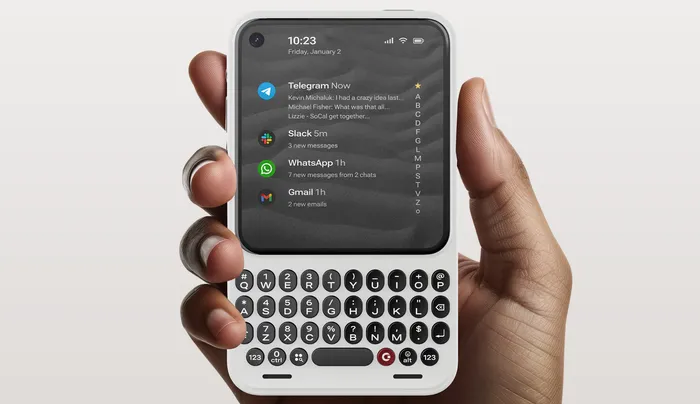
Image: Clicks Communicator
Las Vegas’s annual CES tech expo once again pushed the boundaries of what’s possible, from AI-powered industrial systems to smart flashlights that could save your life.
This year’s show reinforced a shift: AI isn’t just software anymore, it’s shaping the devices all around us.
Day 2 came with the announcement that Siemens and Nvidia have expanded their collaboration to embed generative AI deep into industrial automation and “digital twin” systems. These are virtual simulations that can optimise factories, supply chains and heavy-industry workflows before anything is built in the real world. This signals how AI will underpin next-generation enterprise operations.
Razer also debuted an AI-enabled headset that functions as both gaming gear and a smart assistant, alongside a holographic AI companion device that projects an interactive avatar for coaching, task support and conversational AI right from your desk.
On the robotics side there were developments on day 2:
Roborock’s Saros Rover: A stair-climbing autonomous vacuum with mechanical legs that navigates complex home layouts, a major leap for home robotics.
Autonomous airport robots: Several companies showcased robots designed to guide aircraft, handle luggage and streamline airport logistics, hinting at how automation could reduce delays and operational costs.
Withings Body Scan 2 was released. This is a smart scale that measures more than 60 biomarkers, including heart and nerve health offering personalised health insights and trends rather than just weight data.
CES Day 2 delivered a mix of practical, quirky and downright innovative gadgets. Highlights included:
Clicks Communicator: A BlackBerry-style phone with a physical keyboard and expandable storage — a nostalgic nod with modern upgrades.
Dell XPS 14 & 16 (2026): Dell officially revived its iconic XPS lineup with sleek new laptops powered by Intel Core Ultra Series 3 chips, OLED displays and premium aluminium builds — a return to form for the premium PC segment.
Birdbuddy 2 Mini: A compact smart bird feeder with AI bird detection using audio and visual cues, blending nature and connected tech.
Luna Band: A screen-free fitness tracker that operates through voice commands and a companion app, with no subscription fees.
Timeli Flashlight: More than just a torch, it integrates GPS, video and emergency dispatch support, essentially acting as a personal safety device.
Shokz OpenFit Pro earbuds: Wireless open-ear earbuds with advanced noise reduction and premium audio quality.
Upgraded audio tech: New turntables like the Audio-Technica AT-LP7X and all-in-one sound systems like Victrola Soundstage refreshed analogue audio experiences at the show.
Day 2 of CES 2026 highlighted a few clear themes for the local tech and business community:
Firstly, that AI isn’t confined to screens: It’s embedded into physical devices, from PCs to home robots and safety tools creating opportunities for hardware startups and integrators.
Secondly, smart tools can meet real-world problems: Products like safety flashlights and health scanners show that tech with practical utility is gaining traction.
Lastly, premium computing is returning: There was a renewed focus on powerful, design-forward laptops like Dell’s new XPS line signals ongoing investment in productivity and creative hardware.
As global tech giants showcase AI-infused ecosystems and niche innovators build gadgets that blur the line between useful and delightful, CES 2026’s message for South Africa is loud and clear: the future isn’t just intelligent, it’s interactive, practical and increasingly physical.
FAST COMPANY
