
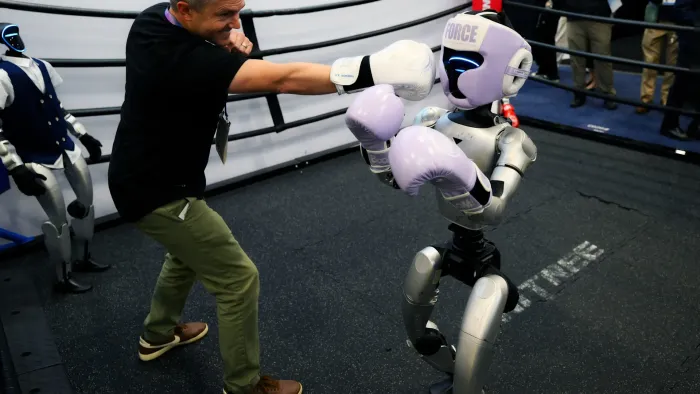
A man is boxing with a Unitree Humanoid Robot at the CES (Consumer Electronic Show) 2026, the world’s largest annual consumer technology trade on January 6, 2026 at the Las Vegas Convention Center in Las Vegas, Nevada, United States.
Image: Tayfun Coskun/Anadolu via Getty Images
When the inevitable robot uprising comes, I’ll be ready, thanks to some valuable lessons I picked up at CES. First, if given the choice of a dance off versus hand-to-hand combat, opt for the fight. Second, wear a cup when you do.
Robotics company Unitree showcased its G-1 humanoid robot at the show. The G-1 is a rarity in the robotic world in that it’s already on the market for under $15,000. Unitree’s booth was an ongoing spectacle, surrounded by people eager for a close look at the dapper-looking unit, wearing a white shirt and button-down vest, showcasing impressive dance skills, throwing down moves that even Shabba-Doo and Bugaloo Shrimp could respect.
There was another G-1, too, this one with a decidedly more combative directive.
By sheer luck, I found myself being asked if I’d like to strap on the gloves and go a round with the G-1. After being force-fed the technology for the better part of a week, I wasn’t going to turn down an opportunity to whale on a robot.
The fight seemed fixed from the start, though. The G-1 had headgear. None was offered to myself or any other meatbag who stepped into the ring. Its gloves were a cherry red pair from Everlast. The ones velcro’d onto my hands? Salmon colored.
As the fight started, I knew I had a few advantages – and a few disadvantages. The robot had me beat on strength and stamina, but I had the reach on it. I also had just enough boxing knowledge to know that the best approach was a combination of jabs and upper cuts and to keep my distance.
What I didn’t count on was that my height advantage meant that when the robot began swinging, it was mostly at crotch level.
I landed several solid shots on its chest cavity, sometimes hard enough to push it back and make it stagger, but, good grief, can that thing take a hit?
It just kept coming.
The G-1 was terrible at protecting its head, so I focused my next round of punches square in where its nose would have been, had it had to worry about things like oxygen (which, by that point, I was gulping). That hardly slowed it down, but it might have caused some traumatic cranial injuries, as the robot then threw a wild punch combination in the air, completely off target.
In the interest of science, I did allow it to land a few hits (with my hip turned). While it wasn’t utilising all of its robotic strength when it hit me, I could feel it.
After about four minutes, the robot laid down on the ground and pretended to be knocked out — the company’s way of saying “Ok, time for someone else to have a turn.”When it hopped back up, we posed for a picture together. But I swear it looked ready to throw a few more jabs my way.
ABOUT THE AUTHOR
Chris Morris is a contributing writer at Fast Company, covering business, technology, and entertainment. Chris is a veteran journalist with more than 35 years of experience, more than half of which were spent with some of the Internet’s biggest sites, including CNNMoney.com, where he was director of content development, and Yahoo! Finance, where he was managing editor.
