

.
Image: UpScrolled
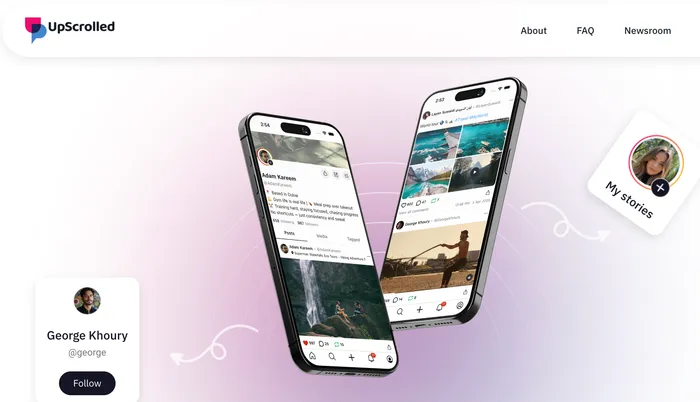
In the turbulent aftermath of shifting global tech ownership and user dissatisfaction with legacy platforms, a new contender has surged: UpScrolled, a social media app that has rapidly climbed app-store charts around the world, including in the U.S. and Europe, as users rethink where and how they share their ideas online.
UpScrolled didn’t emerge from Silicon Valley’s traditional pipeline of VC-backed startups chasing the next viral trend.
Instead, it was created by Issam Hijazi, a Palestinian-Jordanian-Australian technologist frustrated by the way major platforms moderated content, particularly posts related to political crises and underrepresented voices.
Hijazi had climbed the corporate ladder at companies like IBM and Oracle before deciding to build something different: a network where users aren’t at the mercy of opaque algorithms and where “shadowbans” and unseen throttling don’t silence voices without explanation.
Official brand messaging describes UpScrolled as “Built for impact. Driven by purpose. Powered by you!” marketing that signals its core target audience: activists, everyday users who feel unheard, creators seeking transparent reach, small business owners craving direct engagement, and communities that feel sidelined by algorithmic biases.
While every social platform claims universality, the rise of UpScrolled highlights a specific cohort of early adopters:
Creators and activists are tired of having their reach unpredictably restricted on TikTok, Instagram, or X (formerly Twitter).
Communities historically underrepresented or policed on major networks, notably pro-Palestinian voices and political commentators who saw their content deprioritised.
People are disillusioned with big-tech ownership changes, such as TikTok’s highly publicised shift in U.S. ownership that catalysed mass downloads of alternatives.
In this respect, UpScrolled isn’t just another “TikTok competitor,” it’s a reaction to opaque moderation, shifting power in social algorithms, and rising public demand for control and transparency.
Part of UpScrolled’s sudden prominence is tied not just to its technical pitch, but to who is showing up on the platform.
While detailed public user lists are limited, several political figures and entities have established a presence, signalling a broader shift in political digital strategy.
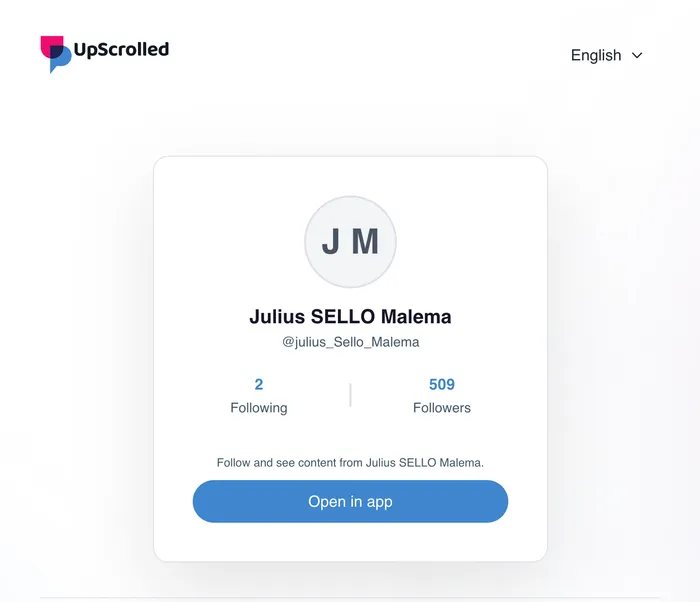
Among them is Julius Malema, the outspoken leader of South Africa’s Economic Freedom Fighters (EFF), who has encouraged followers to connect with the party on UpScrolled.
.
Image: UpScrolled
Malema’s early advocacy for alternative digital engagement reflects two trends: one, that political leaders increasingly see new platforms as spaces to reach voters outside traditional media, and two, that high-profile figures perceive value in being early adopters rather than afterthought users of emerging tech networks.
In a digital age where many South African politicians already command millions of followers on X (formerly Twitter), platforms like UpScrolled represent an extension of that reach into fresh territory.
Though precise uptake among other local politicians isn’t yet fully mapped, the fact that figures like the EFF and its leadership are experimenting with UpScrolled underscores a broader political experiment: choosing platforms that align with messaging goals, audience engagement, or simply new avenues for unfiltered communication.
UpScrolled’s ascendancy, and the political interest it has attracted, exemplifies a wider shift: users are no longer downloading every new app by default.
The frenetic social-media adoption of the 2010s and early 2020s is giving way to intentional selection.
Consumers today are asking:
What does this platform stand for?
Whose interests does it prioritise?
Is it driven by hidden algorithms or transparent rules?
Does it respect or exploit my attention and data?
This trend reflects a more mature digital public that treats social platforms like curated spaces rather than obligatory digital town squares.
UpScrolled’s pitch, equal opportunity for visibility without pay-to-play models or black-box content suppression, hits a nerve in a moment when trust in mainstream social networks is at a low point and when users are increasingly aware of the power dynamics baked into platform design.
For South Africans, where social media is already deeply embedded in political, cultural, and social life, a platform like UpScrolled offers both opportunity and caution. Users here are sophisticated social natives; they know the pitfalls of algorithmic bias and corporate ownership.
They also know that early experimentation doesn’t always translate to long-term engagement.
Still, the evidence suggests that the age of blind adoption is over.
Whether it’s driven by political discourse, algorithm fatigue, or a desire for new digital dialogues, platforms like UpScrolled are attracting attention not just as novelty apps, but as potential alternatives shaped by principles and chosen by users with purpose.
FAST COMPANY (SA)
